

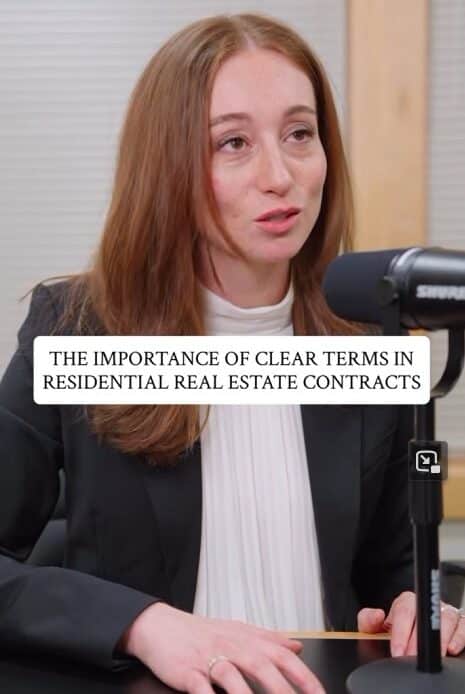
Residential real estate transactions can look straightforward from the outside. There is a property, a buyer, a seller and an agreed-upon price. Because these transactions happen every day, it is easy to assume that the contract is simply a standard document confirming the basic terms of the deal.
In reality, the details written into a New York residential real estate contract can determine much more than the purchase price and closing date.
Who is responsible for repairs? Is the seller providing a credit instead of completing the work? Will money be held in escrow after closing? What happens if a required repair cannot be completed before the parties are ready to close? Are there obligations that continue even after ownership of the property has transferred?
These details can have real financial consequences.
That is why buyers and sellers should pay close attention not only to the standard language in a residential contract, but also to every rider, handwritten modification, repair agreement and additional term that becomes part of the transaction.
Residential transactions may seem repetitive, but the important terms are not always the same from one deal to the next. Understanding exactly what has been agreed to—and making sure those terms are clearly documented—can help prevent disagreements before, during and after closing.
A “Standard” Contract Does Not Mean a Standard Transaction
Many residential real estate transactions begin with standardized contract forms. Those forms provide a useful framework, but the property and circumstances surrounding each sale are different.
A transaction may involve:
- Repairs that must be completed before closing
- Credits negotiated after an inspection
- Appliances or fixtures that must remain with the property
- An unresolved permit or violation
- Work that cannot be finished before closing
- Funds that need to remain in escrow
- A seller who needs additional time in the property
- Obligations that continue after the closing
- Unique financing or timing requirements
These are often the issues that distinguish one transaction from another.
The New York Attorney General recommends that home buyers have their own attorney review contracts before signing and ask about provisions they do not fully understand.
The goal should not simply be to get the contract signed. It should be to make sure the written agreement accurately reflects what the buyer and seller believe they have agreed to.
In New York, What Is Written Matters
When a disagreement develops later, the parties may need to rely on what was actually put into writing.
That principle is especially important in real estate transactions.
New York law generally requires contracts for the sale of real property to be in writing, and New York courts ordinarily enforce clear and unambiguous written agreements according to their terms.
This means a conversation between the parties, an informal understanding or an assumption about what someone intended may not provide the same protection as a clearly drafted contractual obligation.
If a seller has agreed to repair a leaking roof, for example, the contract or an appropriate written agreement should identify what the seller is actually required to do.
Simply writing “seller to repair roof” can leave unanswered questions:
- What portion of the roof must be repaired?
- Who will perform the work?
- Does a licensed contractor need to be used?
- Must the repair be completed before closing?
- Does the buyer have a right to inspect the completed work?
- What happens if weather or contractor availability delays completion?
- What happens if the repair costs significantly more than expected?
The more important the obligation, the less the parties should have to rely on assumptions.
Repair Agreements Should Be Specific
Home inspections frequently lead to additional negotiations between buyers and sellers.
An inspector may identify an issue with a roof, plumbing system, electrical panel, HVAC equipment, foundation or another part of the property. The parties may then agree that the seller will correct the condition before closing.
That agreement should be specific enough for both parties to understand when the obligation has been satisfied.
Consider the difference between:
“Seller will repair the HVAC system.”
and a provision that identifies the affected equipment, specifies that a qualified contractor will perform the repair, establishes when the work must be completed and explains what documentation will be provided to the buyer.
The second approach gives the parties considerably more clarity.
Clear language cannot guarantee that a disagreement will never occur, but it can substantially reduce uncertainty about what each party agreed to do.
Credits Need to Be Clearly Defined Too
Sometimes the parties decide that it makes more sense for the buyer to receive a credit rather than have the seller complete a repair.
That may sound simple, but the details still matter.
The agreement should make clear:
- How much the credit will be
- What the credit relates to
- Whether it is being applied at closing
- Whether either party has additional responsibility if the actual repair ultimately costs more
A buyer who accepts a $5,000 credit toward a repair may have a very different agreement from a buyer whose seller has promised to complete that repair regardless of cost.
Those distinctions should not remain unclear until closing.
Escrow Holdbacks Can Protect Unfinished Obligations
Sometimes a transaction is ready to close even though a specific issue has not been resolved.
For example:
- A repair may still need to be completed.
- A final water bill may not yet be available (particularly in New York City).
- A permit or municipal issue may remain outstanding.
- Work may be delayed because of weather.
- Documentation may still need to be provided.
Instead of postponing the entire closing, the parties may agree to place money in escrow.
An escrow holdback generally allows part of the seller’s proceeds to remain with an agreed-upon escrow agent until specified conditions have been satisfied.
But an escrow agreement should answer several important questions.
How much money will be held? Who controls it? What exactly must occur before the funds can be released? Is there a deadline? What happens if the cost of completing the obligation exceeds the amount being held?
New York litigation provides examples of post-closing escrow arrangements becoming the focus of later disputes when parties disagreed about repairs, outstanding charges or the release of funds.
The terms governing that escrow matter.
Some Obligations Continue After Closing
Buyers and sellers sometimes assume that once the deed has been transferred and the closing is complete, the contract no longer matters.
That is not always the case.
Certain obligations may specifically survive closing.
The parties should know which contractual obligations end at closing, and which are intended to continue afterward.
If an obligation is supposed to survive closing, that should be documented clearly.
Otherwise, the parties may have very different expectations after the closing table has already been cleared.
Be Careful With Handwritten Changes and Last-Minute Agreements
Residential deals evolve.
An inspection occurs. A new issue is discovered. The buyer requests a repair. The seller offers a credit. Someone writes an additional term into a rider or modifies an existing provision.
Those changes may appear minor compared with the rest of the contract, but they can become some of the most important language in the entire agreement.
A handwritten sentence dealing with a $20,000 repair can matter far more to the parties than pages of standard contractual language that never become an issue.
The same principle applies to last-minute agreements reached shortly before closing.
If the parties agree that something will happen differently from what the existing contract requires, the modification should be properly documented rather than left as an informal understanding.
Credits, Repairs and Escrows Should Work Together
Another potential source of confusion is having multiple provisions addressing the same issue without clearly explaining how they relate to one another.
Suppose an inspection identifies water damage.
The seller initially agrees to repair it. Later, the parties decide that the seller will instead provide a credit. Then a contractor determines that part of the work cannot be completed before closing, and the attorneys discuss an escrow holdback.
At that point, several questions need to be resolved:
- Is the seller still obligated to make the original repair?
- Does the credit replace that obligation?
- Is the escrow in addition to the credit?
- Who is responsible if the repair ultimately costs more?
- When can the escrow funds be released?
- Does any responsibility survive closing?
The final written agreement should make the answer clear.
Otherwise, each party may leave the transaction believing something different.
Clear Contracts Protect Both Buyers and Sellers
Detailed contract language is not only for buyers.
Sellers also benefit when their obligations are clearly limited and defined.
Good contract drafting is not about making one side’s obligations as broad as possible.
It is about making sure both parties understand the agreement.
Sabrina Rabban, Esq. PLLC assists buyers and sellers with residential real estate transactions, contract negotiations and related disputes throughout Nassau County, Suffolk County, Long Island and New York City.
Contact Sabrina Rabban, Esq. PLLC to discuss a residential real estate contract or upcoming transaction.
This article is provided for general informational purposes only and does not constitute legal advice. Real estate transactions and contractual rights depend on the specific language of the agreement and the circumstances involved. Reading this article or contacting the firm does not create an attorney-client relationship.